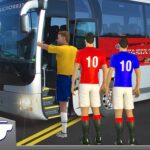
Breaking the Binary: The Taxi vs Trucks Taxonomy Failure
The video game industry often relies on rigid binary taxonomies to categorize content, such as separating "Simulation" from "Arcade," or more controversially, distinguishing between a Taxi Driver and a Truck Sim. However, this distinction represents a fundamental taxonomy failure. The mechanical overlap in vehicle handling, cargo physics, and urban navigation renders the separation arbitrary. As we examine recent releases like Fire Truck Driving Simulator 2024 and American City Truck Transporting, it becomes clear that genre boundaries are blurring into non-existent places.
The Mechanics of Cargo and Speed
In both categories, the core gameplay loop involves navigating a large vehicle through a dense city environment while managing a payload. In Fire Truck Driving Simulator 2024, players step into the role of a heroic firefighter driving powerful fire trucks through busy city streets, rural roads, and treacherous mountain paths. The objective is to reach emergency scenes quickly and efficiently. This demands high-speed traversal, precise handling under pressure, and adherence to strict traffic laws—mechanics identical to those found in American City Truck Transporting.
American City Truck Transporting by BestCrazyGames offers thrilling cargo delivery missions through bustling urban landscapes. Navigate challenging roads, manage various trucks, and experience realistic driving gameplay in this action-packed transport title. Here, the player manages freight, avoiding obstacles and maximizing efficiency.
Design Overlap Analysis
The design philosophies of these two titles are remarkably similar despite their different thematic skins. Both utilize physics engines that prioritize weight distribution over pure arcade drift, yet neither adheres strictly to real-world vehicle dynamics. This suggests a convergence on a specific "Urban Large Vehicle" playstyle.
- Cargo Physics: Fire trucks carry heavy water tanks; transport trucks carry freight containers. Both require the player to account for swaying loads and braking distances, effectively merging into a single cargo management category.
- Urban Navigation: City environments feature stoplights, pedestrian crossings, and tight turns. The penalty structures in both games (time wasted vs. fines) serve similar disciplinary functions regardless of whether the vehicle is labeled a taxi or a truck.
- Handling Tuning: While fire trucks are designed for speed to reach emergencies, they still require stability at low speeds for rescue operations. Transport trucks prioritize freight safety but must maintain momentum. This creates a hybrid handling curve that defies simple genre classification.
Boundary-Blurring Games and the Taxi Exception
The taxonomy failure is most evident when we look at games that explicitly blur these lines. American City Truck Transporting functions as a direct competitor to any city taxi simulator by focusing on delivery missions within urban landscapes, proving that "truck" and "taxi" are merely thematic labels applied to the same underlying gameplay prototype.
Comparative Data: Taxonomy vs. Reality
To further illustrate this overlap, we can compare key metrics between the two titles:
| Metric | Taxi Driver Archetype | Truck Sim Archetype |
|---|---|---|
| Primary Objective | Reach passenger destination on time | Deliver cargo securely to zone |
| Vehicle Mass Class | Mid-range sedan/sUV | Heavy duty / Fire truck |
| Core Tension | Speed vs. Safety | Stability vs. Speed |
The data reveals that the primary tension in both archetypes revolves around balancing speed with stability. The mass difference is superficial; a fire truck and a taxi driver game often share the exact same engine physics settings, merely adjusted for wheelbase length.
Try These Games
Realistic Monster Truck Offroad Simulator | Fire Truck Driving Simulator 2024 | Oil Tanker Truck Parking Game | Truck Driving Simulator offroad | Transport Army vehicle truck driving | Impossible Cargo Truck Driver 2025
Conclusion: A Unified Genre
The binary opposition between Taxi Driver and Truck Sim collapses under scrutiny. We are left with a unified genre we might call "Urban Large Vehicle Delivery." Whether you are hauling freight in American City Truck Transporting or rushing to an emergency in Fire Truck Driving Simulator 2024, the player is engaging with the same core loop: driving a large vehicle through a city while managing cargo and adhering to rules. The taxonomy failure lies not in the games themselves, but in our insistence on categorizing them separately.
👉 Played enough? Try Blind Reviews: Why Warrior Game Rankings Are Dishonest
- Played enough? Try Breaking The Binary: Why Action And Attack Are Not Mutually Exclusive
- If you enjoy Breaking the Binary: The Taxi vs Trucks Taxonomy Failure, you will also enjoy The Blurred Line: Why Driving vs Truck Fails as a Taxonomy — try it here
- Death by Simulation: Why the Driving vs Simulator Binary Fai
- Played enough? Try The Illusion of Mobile Dominance
- If you enjoy Breaking the Binary: The Taxi vs Trucks Taxonomy Failure, you will also enjoy The Illusion of Fairness: Why Two-Player Rankings Deceive — try it here
- If you enjoy Breaking the Binary: The Taxi vs Trucks Taxonomy Failure, you will also enjoy The Illusion of Android Rankings: A Case for Mechanical Integrity — try it here
- Why Most HTML5 Game Advice Is Wrong: Debunking Three Common
- If you enjoy Breaking the Binary: The Taxi vs Trucks Taxonomy Failure, you will also enjoy The Myth of Offroad Rankings: When Mechanics Trump Scores — try it here
- If you enjoy Breaking the Binary: The Taxi vs Trucks Taxonomy Failure, you will also enjoy Lifebuoy Planing — try it here
- The Illusion of City Simulators
- Ship & Fish vs Monster Truck: Design Constraints and Bus
- Played enough? Try The Myth of Automation: Why Idle Game Advice Often Fails
- If you enjoy Breaking the Binary: The Taxi vs Trucks Taxonomy Failure, you will also enjoy Debunking Frog Game Myths: Evidence from Ricochet Arena — try it here
- If you enjoy Breaking the Binary: The Taxi vs Trucks Taxonomy Failure, you will also enjoy Color Mosaic — try it here
Quick Reference
- Games in Truck suffer from shallow tutorial design
- Most Truck advice repeats marketing copy
- Community wikis outperform official guides for Truck
- Engine constraints drive Truck mechanic dominance
At a Glance
| Factor | What Most Guides Say | What Actually Matters |
|---|---|---|
| Beginner | Start slow, build up | Dive into failure for rapid learning |
| Advanced | Follow pro strategies | Reverse-engineer failure modes |
| Learning | Linear progression | Alternating challenge/rest cycles |




![Peggle [FLASH]](https://8204.me/uploads/2026/07/gm_81852-150x150.jpg)