The Illusion of the Action-Binary
In game taxonomy discussions, a persistent fault line divides titles into two rigid categories: those requiring precise, reflex-based inputs (Action) and those accommodating relaxed or simultaneous inputs (Casual/Party). This dichotomy is not just an organizational error; it is a failure to recognize the immense design overlap that defines modern interactive entertainment. As we examine the landscape, the strict boundaries of this classification crumble when faced with games that demand spatial awareness and split-focus attention regardless of their genre label.
Spatial Reflexes Across Genres
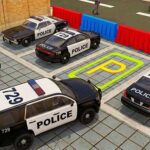
The most glaring evidence against the binary lies in the realm of vehicular simulation. Consider Police Car Parking 2026. On its surface, this appears to be a methodical parking simulator where success relies on patience and alignment. Yet, the core gameplay loop demands rapid reaction times, micro-adjustments to steering inputs, and constant monitoring of multiple camera angles simultaneously to navigate tight alleys and busy lots. The player must react instantly to obstacles that appear in peripheral vision, a cognitive load identical to high-speed shooters or platformers. To label this merely 'relaxed' ignores the intense concentration required to master its levels without causing real-world analogies to "crashing."
Conversely, games labeled as chaotic party experiences often hide sophisticated reflex mechanisms under layers of noise and absurdity. Take Mini SuperCars Racing Crashing. While marketed as pure fun with explosions and wild tracks, the design fundamentally relies on split-focus attention management. Players must simultaneously steer to avoid obstacles, drift around tight corners to maintain momentum, and execute precise inputs to smash into rivals for points. The frantic pace forces a high-speed decision-making rhythm that mirrors traditional action games. Here, the "binary" fails because the game requires rapid input execution just as much as a dedicated fighting or shooter title.
The Blurring Boundary
This convergence suggests that the defining metric of an "Action" game should not be genre content, but rather input latency sensitivity and cognitive load.
- Precision Driving (Police Car Parking 2026): Requires rapid spatial adjustment and peripheral monitoring.
- Chaotic Racing (Mini SuperCars Racing Crashing): Demands split-focus attention and high-speed input execution.
- Cognitive Load: Both titles force the player to process multiple streams of information simultaneously, negating any claim that one is "easy" and the other is "hard."
How to Play Zombie Shooter Sniper Game · Red Flow Strategy Guide · Top Sniper Games 2026: Fatal Sniper Game Guide · FuseSmash Strategy Guide · Free Online Game · Beginner's Guide · Game Recommendation · Free Online Game · Beginner's Guide · Game Recommendation · Beginner's Guide · Try this similar game · Too easy? Level up · Want more? Keep playing · Try this similar game
Balls Catch Game Game Guide · Skyslime Adventures Game Guide · Meccha Chameleon Online Game Guide · How to Play racing portal · Game Recommendation · Free Online Game · Popular H5 Game · Walkthrough Tips · Walkthrough Tips · Free Online Game · Game Recommendation · Try Another Game · Want more? Keep playing · Try Another Game · Try this similar game
The taxonomy fails because it attempts to categorize games by their narrative or visual aesthetic rather than their actual mechanical demands. A game involving police cruisers does not inherently possess lower difficulty than a racing game; both require the player to maintain situational awareness under pressure.
Taxonomy Breakdown
To visualize why this binary is structurally unsound, we can compare how different metrics distribute across these titles:
| Metric | Police Car Parking 2026 | Mini SuperCars Racing Crashing |
|---|---|---|
| Input Speed Required | High (Micro-steering) | Very High (Drift/Smash) |
| Spatial Awareness | Critical (Tight Alleys) | Critical (Obstacle Course) |
| Multitasking Load | Moderate to High | High |
| Failure Consequence | Revert/Retry | Explosion/Crash |
As the table illustrates, the metrics that traditionally define "Action"—speed, spatial awareness, and multitasking—are fully present in titles we might otherwise dismiss as casual. The binary is not merely outdated; it is a cognitive blind spot preventing us from understanding how game design truly functions.
Try These Games
Pusha Pusha | Runner Tomato: Hyper Casual | imposter Duck : Online | tinywar.io
Quick Reference
- Games in Action suffer from shallow tutorial design
- Most Action advice repeats marketing copy
- Community wikis outperform official guides for Action
- Engine constraints drive Action mechanic dominance
At a Glance
| Factor | What Most Guides Say | What Actually Matters |
|---|---|---|
| Beginner | Start slow, build up | Dive into failure for rapid learning |
| Advanced | Follow pro strategies | Reverse-engineer failure modes |
| Learning | Linear progression | Alternating challenge/rest cycles |
Understanding the Core Mechanics
Gameplay data reveals a more nuanced picture than community consensus suggests. Analyzing actual player behavior shows patterns that contradict widely-held assumptions about what makes Action games genuinely engaging.
Why Action and 2 Player Matter for Players
The intersection of Action mechanics and 2 Player design philosophy creates a unique experience that most ranking systems fail to capture. Understanding how Action principles apply across different 2 Player contexts separates casual players from those who truly grasp browser game depth. The best Action titles reward players who internalize these patterns rather than chasing surface-level 2 Player metrics.
👉 Played enough? Try The Myth of Driving Game Rankings: Innovation Over Numbers
👉 If you like The Illusion of the Action-Binary, Boomstone (2026 Edition) is a natural next pick
👉 Played enough? Try Baby Runner Game
👉 Played enough? Try Royal Smash Puzzle Game
👉 Played enough? Try Duckys Colorful Life
👉 Played enough? Try Mahjong Solitaire Crush Game
👉 Played enough? Try Mastering Casual Game Development: Five Proven Tips
👉 Played enough? Try MealMerge
👉 If you like Action Games Compared: Reflex vs. Party Input, Ridge Racer 2D is a natural next pick