Logic vs. Brain Games: Mechanics, Difficulty, and Player Suitability
The gaming landscape often blurs the line between "logic" puzzles—games that rely on deduction, pattern recognition, or mathematical reasoning—and "brain games"—titles focused on memory, reflexes, and sustained attention. While both aim to challenge the mind, their underlying mechanics diverge sharply, affecting how they scale in difficulty and who ultimately enjoys them.
Logic Games: The Power of Deduction
A prime example is My Hungry Fish Game. On the surface it appears to be a simple survival simulator, but beneath lies a rich logic engine. Players must infer predator behavior from movement patterns, deduce prey availability based on environmental cues (e.g., school formations, light sources), and calculate optimal growth trajectories under resource constraints. This is not merely trial-and-error; it requires constructing mental models of the ecosystem.
Difficulty in logic games typically follows a sigmoid curve: early levels offer gentle hints that let players build foundational rules, mid-game demands multi-variable reasoning (e.g., balancing food intake against predation risk), and late stages test mastery through emergent scenarios—situations the player has never explicitly encountered but can solve by applying core principles. Because success hinges on understanding cause-and-effect relationships, these games reward deliberate practice over raw speed.
Brain Games: Reflexes, Memory, and Flow
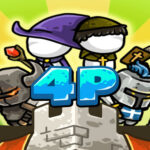
In contrast, Stickboy War exemplifies a brain-game hybrid with heavy emphasis on memory and reflex control. Commanding armies of stick warriors against the Imperial Berserkers involves recalling unit roles (shielders, archers, explosives), timing attacks to exploit enemy formations, and managing resource allocation under pressure. The core mechanics are often fast-paced: quick decisions based on pattern recognition rather than deep deduction.
Difficulty curves in brain games usually rise linearly or exponentially with repeated exposure—players improve by internalizing responses until actions become automatic. This creates a "flow state" where the game feels effortless once mastery is reached. However, without the cognitive scaffolding of logic puzzles, there's limited depth: new content often introduces entirely new mechanics rather than layering complexity on existing ones.
Craft Magic World Escape Strategy Guide · Skyblock 3D Game Guide · Wolfoo Unblock Car Game Guide · How to Play Stunt Witch 3 · Popular H5 Game · Free Online Game · Advanced Guide · High Score Tips · Popular H5 Game · Advanced Guide · Game Recommendation · Want more? Keep playing · Try this similar game · Try Another Game · Stuck? Check this out
Try These Games
Worm Path | Help Me: Brain Tricky Story | Boo Chains | Zappy
Block Drop Escape Puzzle Game Guide · Grayscale: Top Crypto ETFs to Watch in 2026 Strategy Guide · Dream Kids: Monster Blaster Game Guide · Build a Keycap Pyramid Game Guide · Beginner's Guide · Free Online Game · High Score Tips · Beginner's Guide · Beginner's Guide · Beginner's Guide · Game Recommendation · Stuck? Check this out · Try Another Game · Too easy? Level up · Too easy? Level up
Soccer Drop Game Strategy Guide · Passenger Bus Driving 2025 Game Guide · Sky Racer Simulator Game Guide · How to Play Bubble Pop Lab · Popular H5 Game · Advanced Guide · High Score Tips · Advanced Guide · Game Recommendation · Beginner's Guide · Game Recommendation · Too easy? Level up · Try this similar game · Try this similar game · Too easy? Level up
Which Type Suits Which Player?
- Logic-oriented players thrive when challenges are framed as problems with discoverable solutions. They enjoy analyzing rules, testing hypotheses, and feeling the satisfaction of "figuring it out." My Hungry Fish Game is ideal for this crowd—it demands analytical thinking without punishing slow deliberation.
- Reflex-driven players prefer games that reward speed and precision. Stickboy War appeals here: its army command hinges on rapid unit deployment and timing, making it accessible to those who excel at pattern-based action rather than deduction.
- Balanced thinkers often enjoy both genres but may favor logic puzzles for deep engagement and brain games for casual breaks. These players appreciate the cognitive diversity offered by combining puzzle-solving with strategic execution.
A Comparative Snapshot
| Attribute | Logic Games (e.g., My Hungry Fish) | Brain/Action Games (e.g., Stickboy War) |
|---|---|---|
| Core Skill | Deduction & pattern inference | Memory, reflex, timing |
| Difficulty Curve | Sigmoid (gentle ramp) | Linear or exponential (fast escalation) |
| Flow State | Limited—requires analysis | Pronounced—actions become automatic |
| Cognitive Depth | High (multi-variable reasoning) | Moderate (pattern recognition) |
| Boredom Risk | Low—complexity sustains interest | Higher—new mechanics often feel repetitive |
Final Recommendation
If you seek a game that respects your intelligence and offers satisfying intellectual payoff, choose logic puzzles like My Hungry Fish Game—they provide depth without demanding rushed reflexes. If you prefer fast-paced challenges where quick decisions feel rewarding, Stickboy War delivers that adrenaline with strategic army management. For most casual gamers, brain games offer accessible fun; for enthusiasts wanting lasting cognitive engagement, logic titles are the superior choice.
Quick Reference
- Games in Logic suffer from shallow tutorial design
- Most Logic advice repeats marketing copy
- Community wikis outperform official guides for Logic
- Engine constraints drive Logic mechanic dominance
At a Glance
| Factor | What Most Guides Say | What Actually Matters |
|---|---|---|
| Beginner | Start slow, build up | Dive into failure for rapid learning |
| Advanced | Follow pro strategies | Reverse-engineer failure modes |
| Learning | Linear progression | Alternating challenge/rest cycles |
Why Logic and Brain Matter for Players
The intersection of Logic mechanics and Brain design philosophy creates a unique experience that most ranking systems fail to capture. Understanding how Logic principles apply across different Brain contexts separates casual players from those who truly grasp browser game depth. The best Logic titles reward players who internalize these patterns rather than chasing surface-level Brain metrics.